Most stocks yield negative returns
Hendrik Bessembinder, a U.S. finance professor, shocked investors with his finding that most stocks yield negative returns over the long term. It’s worth taking a closer look at his latest studies.
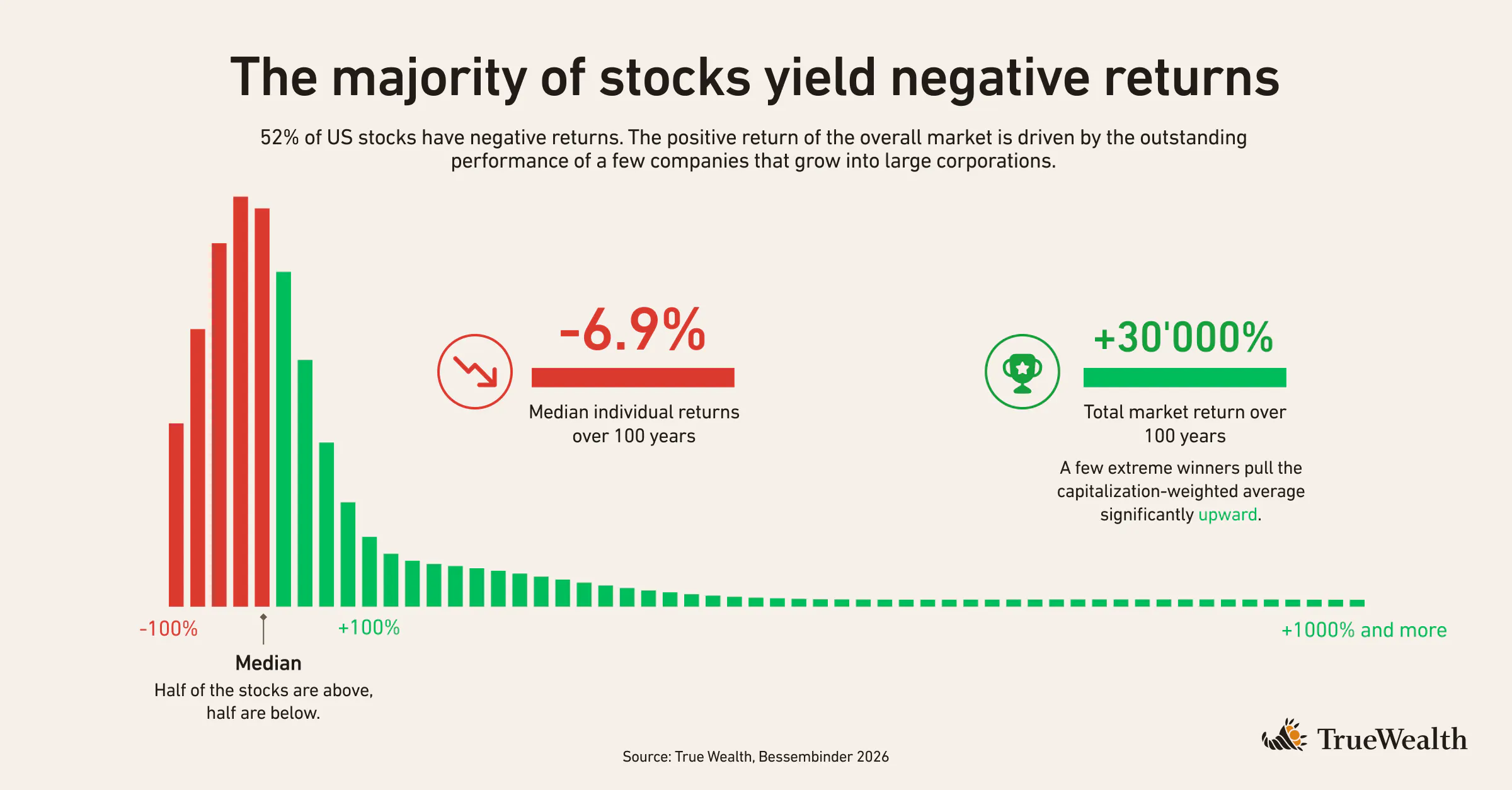
What is the long-term median return on U.S. stocks? Plus five or plus ten percent per year? What do you think? The answer is shocking: minus 6.87 percent over a period of one hundred years.
This is the grim figure arrived at by Hendrik Bessembinder, a finance professor at Arizona State University. To arrive at this figure, he analyzed 29'754 individual U.S. stocks over the period from January 1926 to December 2025.
Of course, very few stocks even last a hundred years, a fact that Bessembinder takes into account. On average, a U.S. stock remains tradable on the stock market for only 11.7 years. The median life expectancy is actually just 6.8 years. In other words: A good half do not survive to celebrate their seventh anniversary as a publicly traded U.S. company. Bankruptcy is not always the reason for delisting. Takeovers, mergers, or going private can also be responsible for a stock’s disappearance from the ticker.
Nevertheless, the surprising short lifespan of stocks suggests that most companies are moderately successful and very few are extremely successful. Just 46 stocks – a mere 0.15 percent of the securities analyzed – account for half of the staggering 91 trillion US dollar in value created. Apple alone is responsible for 5 trillion dollar of this wealth creation. It is followed by Nvidia with 4.6 trillion dollar and Microsoft with 4 trillion dollar.
The cumulative growth of all stocks represents a 30'621 percent increase over a hundred years of «buy and hold.» This makes it all the more astonishing that only 48.2 percent of the stocks analyzed generated a positive total return (in dollars) for investors. And only about 41 percent outperformed the risk-free rate – as measured by short-term U.S. Treasury bonds.
A prime example of this is Nvidia, whose stock has posted a staggering annual return of over 37 percent since its initial public offering in January 1999. As a result, the stock’s value has increased nearly five thousandfold. Netflix has, after all, delivered an annual return of 32.5 percent to its shareholders since its IPO in May 2002.
The «old economy» has also made positive contributions: Altria Group and IBM, for example, were already listed on the stock exchange as early as 1926. Since then, they have delivered impressive annualized total returns of 16.5 and 13.6 percent, respectively. Coca-Cola and Exxon Mobil have also gone the distance. Their total returns of 12.7 and 11.5 percent are nothing to sneeze at.
No one knows in advance which companies will be the next high-flying publicly traded stocks. It is almost certain, however, that these will find their way into the leading indices and thus into the corresponding ETFs. If investors choose standard, i.e., market-capitalization-weighted, index funds, they benefit proportionally from the success of the leading corporations. Conversely, the stocks of the many underperforming smaller companies are not – or are no longer – included in the indices and the corresponding ETFs.
Thus, Bessembinder’s latest study reads like a plea for index funds, whose inventor, Jack Bogle, once advised: «Don’t look for the needle in the haystack. Buy the haystack.»
This time-tested advice is further supported by Bessembinder’s earlier study, which he published with several colleagues back in March 2023. At that time, the researchers analyzed as many as 63'765 stocks from 42 countries.
On a global scale, the result was even more striking: The top 2.4 percent of companies accounted for the 75.7 trillion dollar in value growth between January 1990 and December 2020.
About the author

Founder and CEO of True Wealth. After graduating from the Swiss Federal Institute of Technology (ETH) as a physicist, Felix first spent several years in Swiss industry and then four years with a major reinsurance company in portfolio management and risk modeling.
Get started today
Not sure where to start? Open a demo account now and upgrade it to a live account later.