#67 Multi-asset benchmark: The first customized benchmark index for retail investors
Investors often like to compare their performance to a well-known index. Many turn to the MSCI World Index. But is a pure equity index really the right benchmark for your investment strategy? It’s worth taking a closer look.
It’s gratifying to see your portfolio grow in value year after year. But how successful are you really as an investor? To assess this, you need a suitable benchmark. This is typically a comparison index, also known as a benchmark.
Depending on your portfolio’s focus, different indices are appropriate: Those who invest primarily in Swiss stocks often use the Swiss Performance Index (SPI) as a benchmark. For a strong focus on the U.S. market, the S&P 500 is frequently used. And those with a global diversification strategy often compare their performance to the MSCI World.
The limitations of traditional stock indices
However, these traditional stock indices have a critical weakness: they reflect only part of the reality. A broadly diversified portfolio sensibly consists not only of stocks, but also of bonds, real estate, and commodities. A pure stock index falls short here.
In addition, many investors today pursue individual investment strategies. In such cases, a standardized benchmark index is of little significance. It simply does not match the actual composition of your portfolio.
A benchmark that adapts to your strategy
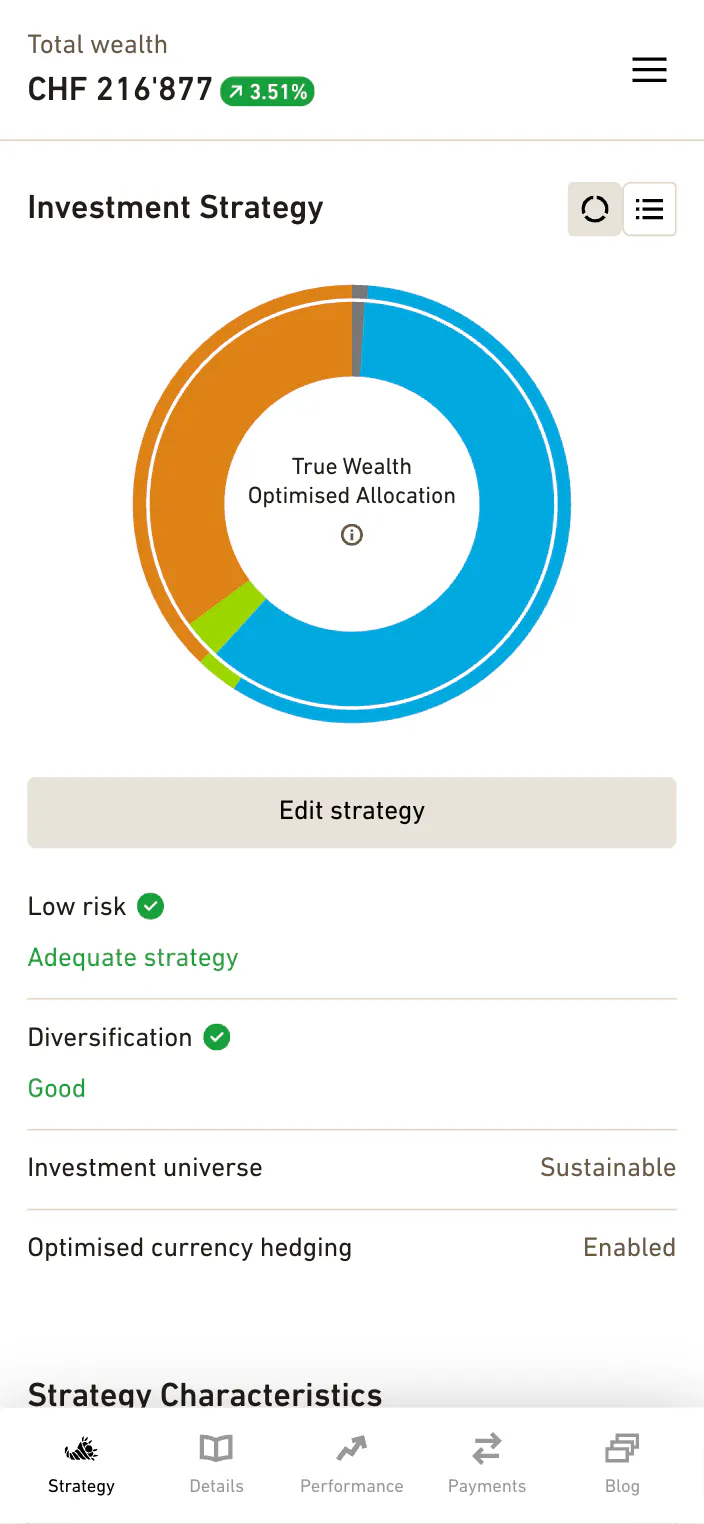
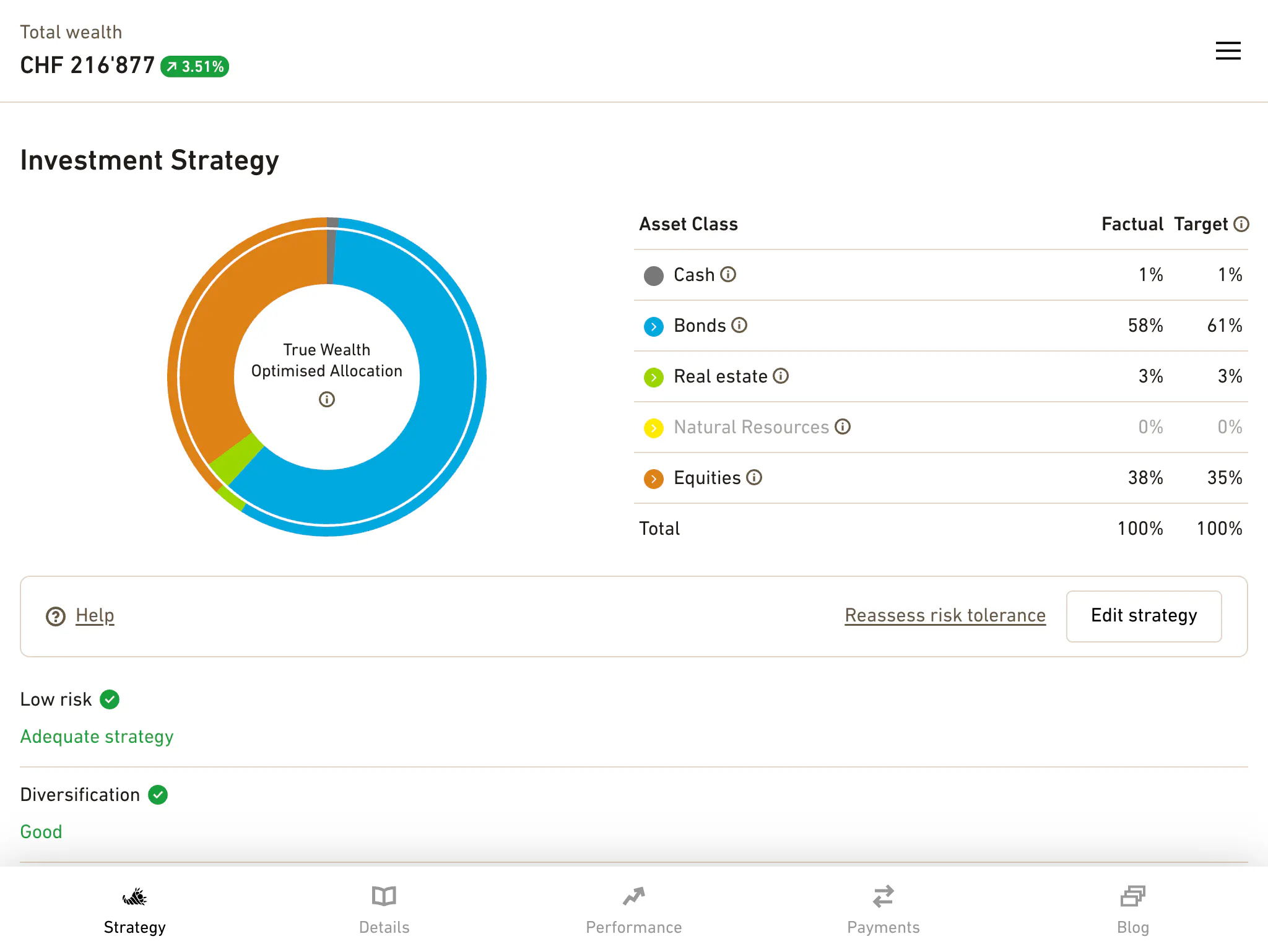
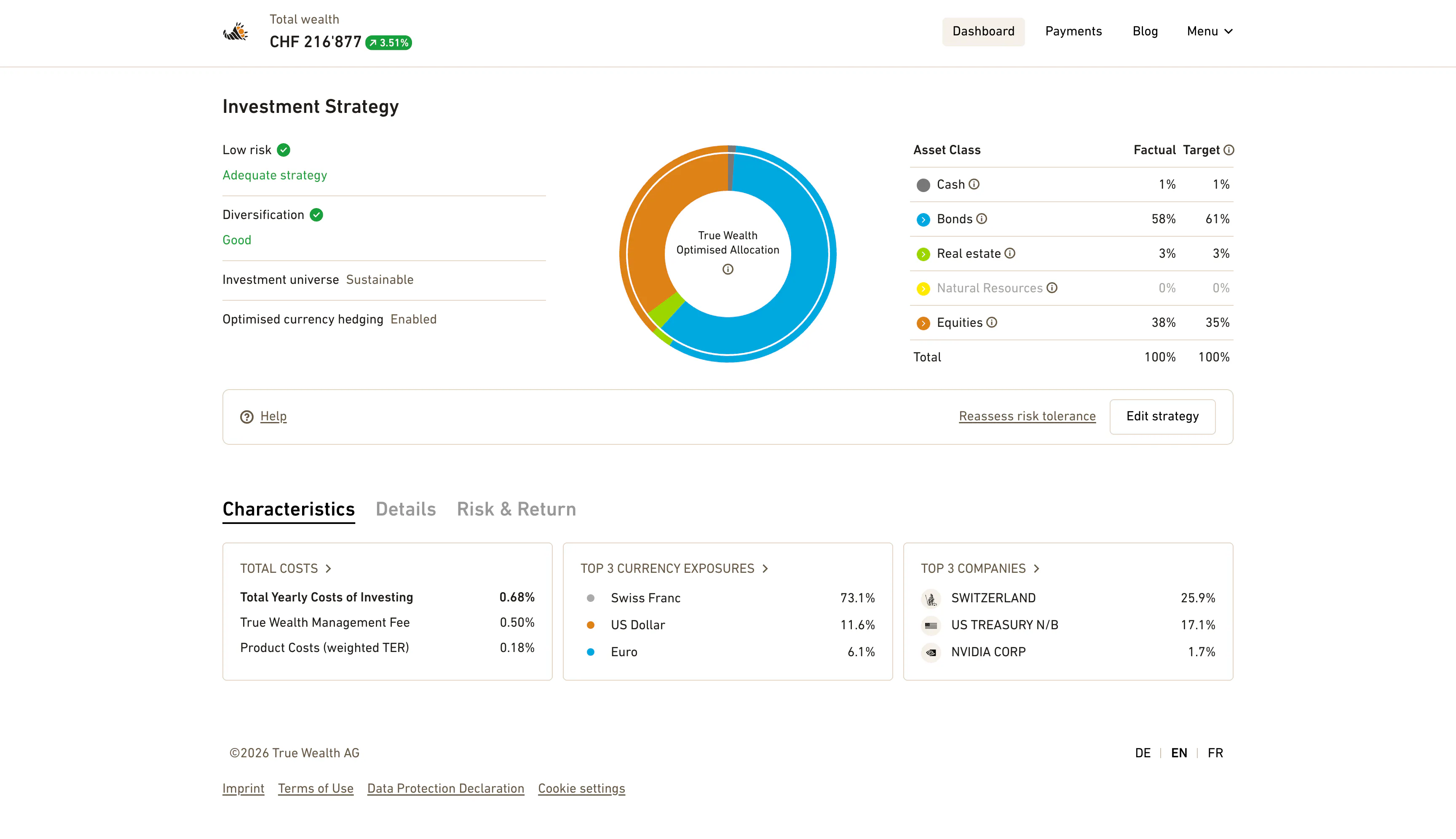
This is exactly where the Multi-Asset Benchmark comes in. True Wealth developed it to reflect the unique structure of your investment strategy as accurately as possible. After all, strategies change over time – whether due to adjustments in strategic asset allocation or changes in your personal financial situation and risk profile.
The Multi-Asset Benchmark takes this dynamic into account: It reflects the actual composition of your portfolio at every point along the timeline. This creates a realistic and fair basis for comparison – even when you adjust your allocation yourself.
More realistic through cost consideration
Another important point concerns costs. Traditional indices do not account for asset management fees or transaction costs, such as those incurred through rebalancing. The multi-asset benchmark, on the other hand, includes a standard flat fee for implementing your strategy. You can also deactivate this if you wish.
The result is a benchmark that is significantly closer to reality than conventional benchmarks. You gain a clearer picture of how efficiently your investment strategy is actually being implemented.
Transparency builds trust
At the same time, transparency ensures that you can understand the calculations at any time. The composition and weightings of your individual benchmark are visible, so you always have a clear overview.
The multi-asset benchmark allows you to accurately assess your performance and objectively evaluate the quality of implementation.
Do you find our multi-asset benchmark useful? Send me an email with your feedback.
About the author

Founder and CEO of True Wealth. After graduating from the Swiss Federal Institute of Technology (ETH) as a physicist, Felix first spent several years in Swiss industry and then four years with a major reinsurance company in portfolio management and risk modeling.
Get started today
Not sure where to start? Open a demo account now and upgrade it to a live account later.