#58 Swiss stocks – a hedge against currency risks?
Swiss stocks are traded in Swiss francs. Many investors therefore assume that they do not bear any currency risk. But is that really true? A look at the past shows that currency also plays an important role in Switzerland.
Do you remember January 15, 2015? On that day, the Swiss National Bank (SNB) took everyone by surprise when it lifted the exchange rate floor against the euro. Within seconds, the franc shot up massively – by over 20 percent in the short term. This event went down in Swiss financial history as the «franc shock» and impressively illustrates the direct effect of currency fluctuations.
Of course, the effect of a strengthening franc can also be observed over longer periods of time. However, other factors always come into play in this case, such as the adaptability of the Swiss economy. Despite these currency fluctuations, the Swiss stock market has managed to gain an average of around five percent over the years.
Impact on bonds and stocks
The SNB has conducted a thorough investigation into the franc shock. The analysis shows that the sudden appreciation of the Swiss currency had only a limited impact on Swiss franc bonds, regardless of whether they were government bonds («Eidgenossen») or corporate bonds. This is not surprising, as these are nominal securities that bear interest and are repaid in francs.
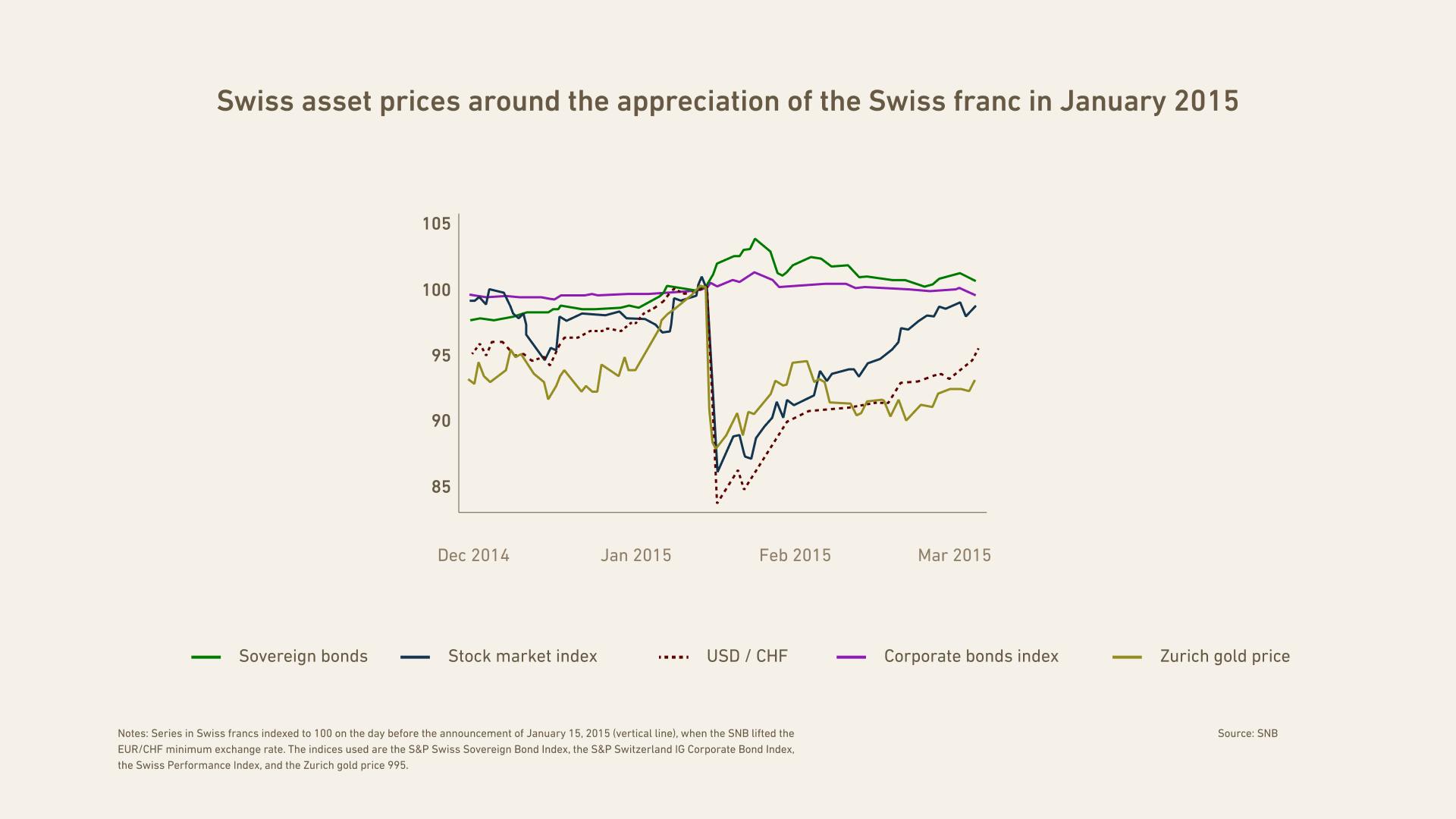
The situation was different for Swiss stocks and commodities such as gold, which lost significant value when measured in Swiss francs. This is understandable: commodities are not only needed in Switzerland; demand for them is global, and they are predominantly traded in US dollars. The strong Swiss franc further exacerbated the situation.
Different reactions from individual companies
Looking at the shares of individual companies, the picture is mixed. The SNB has created a clear chart showing the winners and losers.
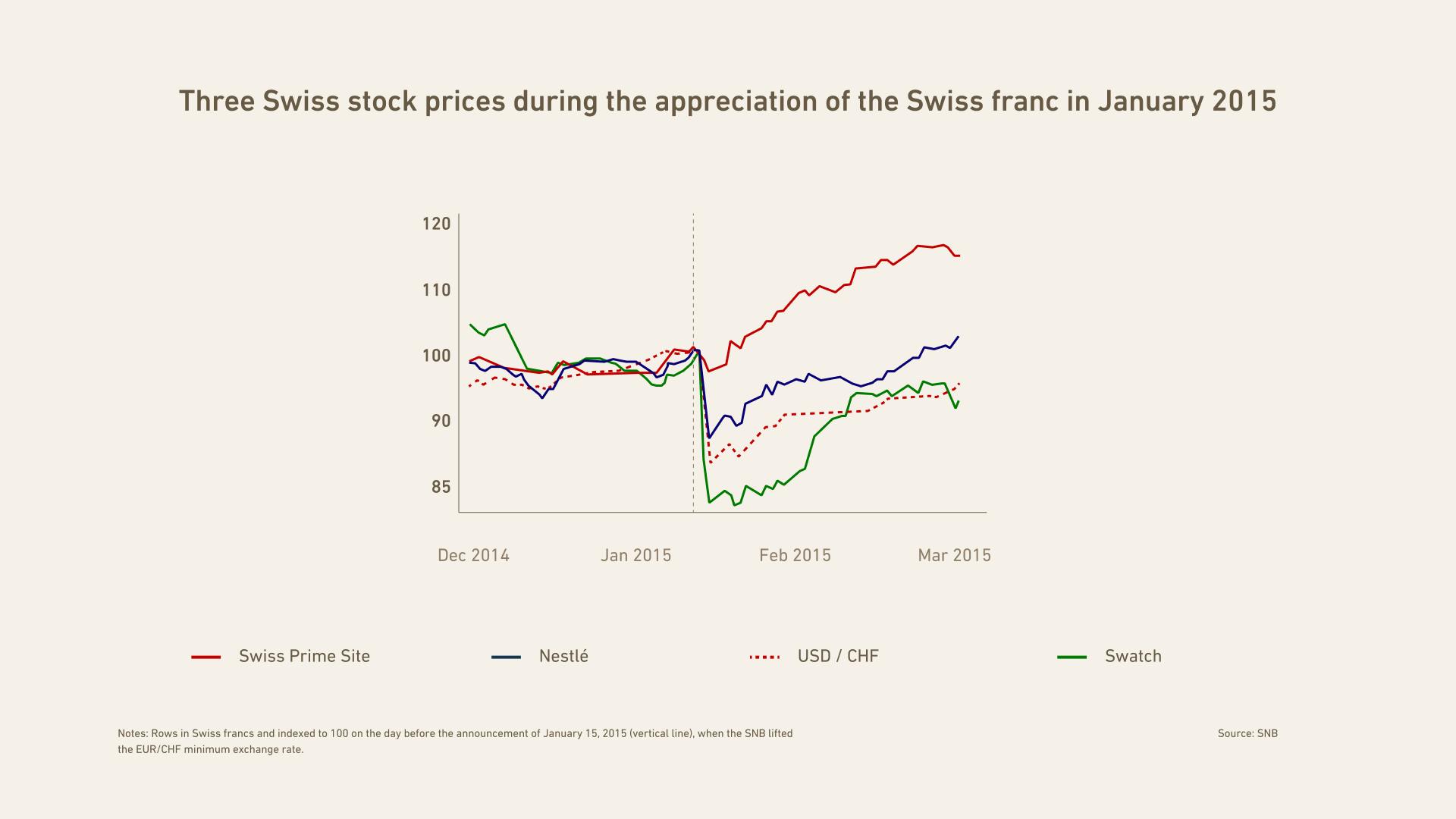
One winner, for example, was real estate developer Swiss Prime Site. The company generates most of its revenue in Switzerland, and imported building materials are likely to have become cheaper. The share price remained stable as a result.
At the other end of the spectrum, Swatch was hit hard. With production in Switzerland and sales mainly abroad, costs were incurred in Swiss francs, while revenues were in foreign currencies. This weighed on future profits, and the market reacted immediately by punishing the shares.
Nestlé lies between these two extremes. The group operates globally and produces much of its output in the respective sales markets. This acts as a natural hedge, so the reaction in Swiss francs was moderate.
Resilience of the Swiss stock market
Overall, it is clear that although the Swiss stock market came under pressure in the short term, it recovered quickly. The Swiss economy is resilient, and many companies are globally positioned. A home bias, i.e., a certain focus on Swiss investments, can be useful, but should not be exaggerated. Diversification remains crucial – across different stocks, markets, and asset classes.
Conclusion for investors
- Keep a cool head when short-term fluctuations occur.
- A certain home bias is acceptable, but should not entail cluster risk. Diversification across different stocks, markets, and asset classes is crucial.
Did you know that Swiss equities can also entail currency risk? Send me an email with your thoughts.
About the author

Founder and CEO of True Wealth. After graduating from the Swiss Federal Institute of Technology (ETH) as a physicist, Felix first spent several years in Swiss industry and then four years with a major reinsurance company in portfolio management and risk modeling.
Get started today
Not sure where to start? Open a demo account now and upgrade it to a live account later.